
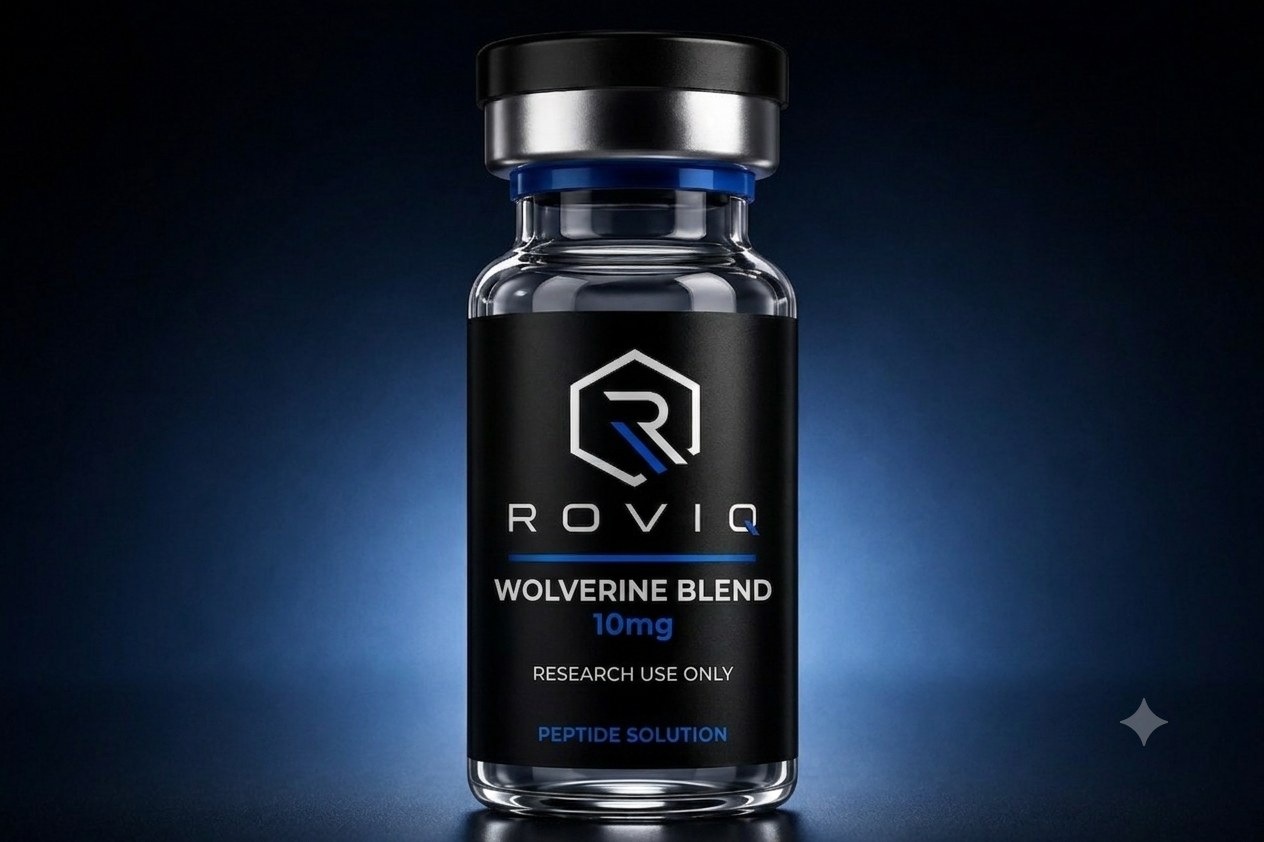
Wolverine Blend (BPC-157 + TB-500)
This combination is commonly studied for its role in tissue repair and recovery processes. Research on BPC-157 and TB-500 suggests potential involvement in cellular regeneration, angiogenesis, and inflammatory response in experimental models. The blend pairs two peptides that have each been examined in preclinical models of musculoskeletal and soft-tissue injury.
Available Options
Research Context
The Wolverine Blend combines two distinct research peptides: BPC-157, a synthetic pentadecapeptide derived from a sequence found in human gastric juice, and TB-500, a synthetic fragment corresponding to the active region of thymosin beta-4, a naturally occurring actin-binding protein. Each has its own preclinical literature, and the combination is commonly used in laboratory settings studying tissue repair biology.
BPC-157 has been examined primarily in animal models, including rodent studies of tendon, ligament, muscle, and gastrointestinal injury, where research has explored its relationship to angiogenesis, growth factor signaling, and nitric oxide pathways. In vitro work has investigated its effects on fibroblast and endothelial cell behavior. Translational reviews note that the evidence base remains almost entirely preclinical, with formulation and bioavailability questions still unresolved.
TB-500 and its parent molecule thymosin beta-4 have been studied in vitro for their role in actin sequestration and cell migration, and in animal models of dermal, cardiac, and corneal injury for their relationship to cell motility and angiogenic signaling. Human data for both peptides are limited, and neither compound is approved for therapeutic use. Our BPC-157 and TB-500 tissue repair research article covers the evidence in more depth.
Open questions include the mechanisms underlying the observed preclinical effects, the pharmacokinetics of both peptides, and whether findings in rodent injury models translate to other systems. This material is supplied as a lyophilized powder with purity verified by HPLC and a published certificate of analysis. It is intended strictly for laboratory research use and is not for human or veterinary use.
Specifications
| Components | BPC-157 + TB-500 (1:1 by mass per vial size) |
| Form | Lyophilized powder |
| Purity | >=99% (HPLC) |
| Storage | Store lyophilized at -20C; refrigerate (2-8C) after reconstitution |
Storage & Handling
Store the lyophilized powder at -20C, protected from light and moisture. After reconstitution, refrigerate at 2-8C and use promptly. For step-by-step handling, see our reconstitution and storage guide and the reconstitution calculator.
Certificate of Analysis
🛡 COA — BPC-157 5mg / TB-500 5mg 🛡 COA — BPC-157 10mg / TB-500 10mgFurther Reading
Related Compounds
References
- Mateescu DM et al. BPC-157 as an Investigational Peptide Therapeutic: Biopharmaceutical Challenges, Formulation Strategies, and Translational Development Barriers. Pharmaceutics. 2026. PMID 42198317
- Mendias CL et al. Safety and Efficacy of Approved and Unapproved Peptide Therapies for Musculoskeletal Injuries and Athletic Performance. Sports Med. 2026. PMID 41966639
- Bock-Marquette I et al. Thymosin beta-4 denotes new directions towards developing prosperous anti-aging regenerative therapies. Int Immunopharmacol. 2023. PMID 36709593
- Ying Y et al. Thymosin beta-4 and Actin: Binding Modes, Biological Functions and Clinical Applications. Curr Protein Pept Sci. 2023. PMID 36464872