
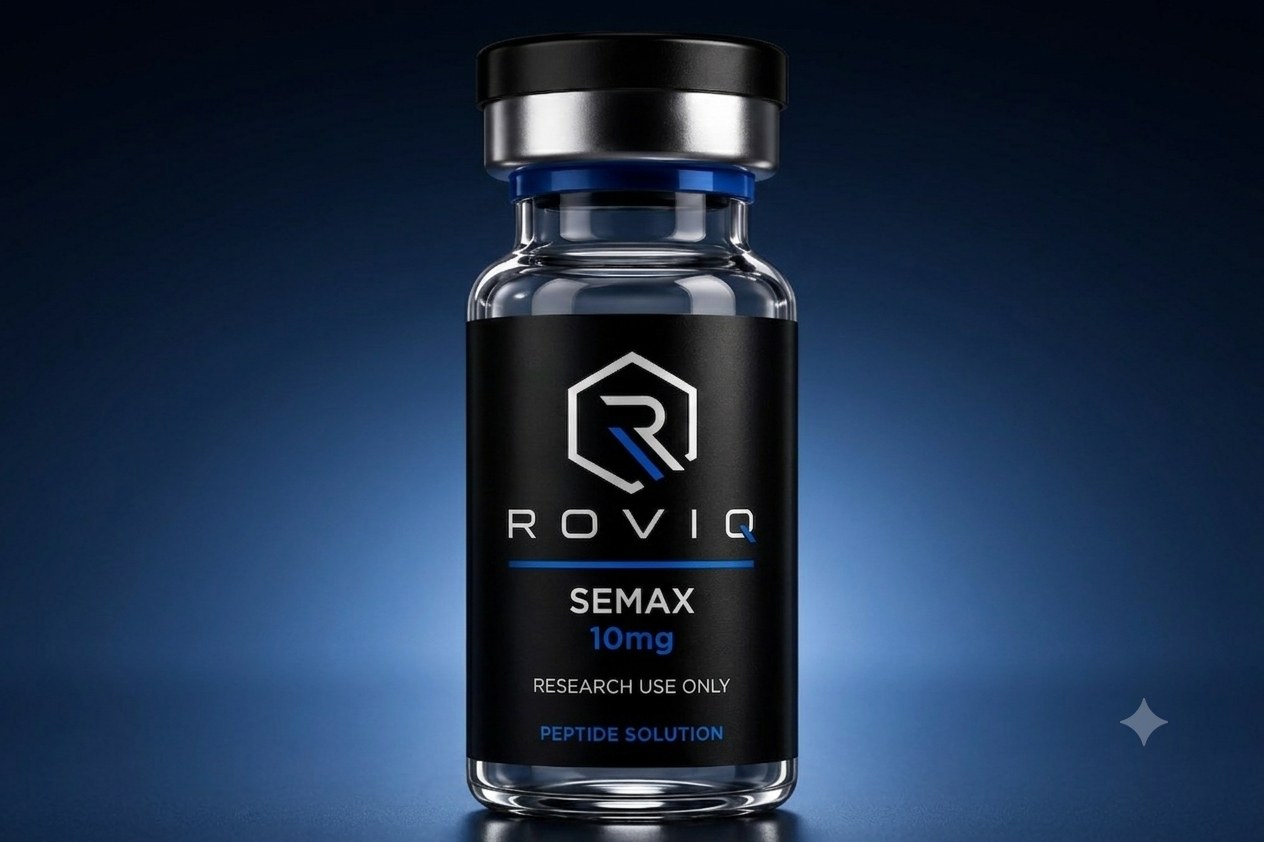
Semax
Semax is a synthetic heptapeptide analog of the ACTH(4-7) fragment of adrenocorticotropic hormone. Research explores its role in cognitive function and neurochemical activity in experimental models, including its potential influence on brain-derived neurotrophic factor (BDNF) and neural signaling pathways.
Available Options
Research Context
Semax is a synthetic heptapeptide (Met-Glu-His-Phe-Pro-Gly-Pro) consisting of the ACTH(4-7) fragment of adrenocorticotropic hormone extended with a C-terminal Pro-Gly-Pro sequence. Like Selank, it was developed in Russia, and a substantial share of the published literature comes from Russian research groups studying melanocortin-derived peptides and their effects on neural signaling pathways in the central nervous system. The peptide is supplied as a lyophilized powder for in vitro and animal research applications.
The evidence base is predominantly preclinical. Animal model studies in rats have examined Semax in the context of cerebral ischemia-reperfusion, with proteomic and transcriptomic analyses reporting modulation of brain protein and gene expression patterns in the days following experimental stroke, including compensation of gene expression profiles disrupted by ischemia. Other rodent work has investigated its effects on intracellular calcium dynamics in brain neurons, on recovery-related gene expression after spinal cord injury in mice, and on molecular markers in an animal model of Alzheimer's disease pathology.
In vitro and molecular studies have focused on how Semax and related ACTH-like peptides influence neurosignaling and immune-related gene expression, including reported effects on BDNF-related pathways and stress-response gene expression in the hippocampus of rats following acute stress. Human data exist but are limited to small, mostly Russian-origin studies, and the findings have not been widely replicated by independent international research groups.
Open questions include the peptide's receptor-level mechanisms, the translational relevance of rodent ischemia and neurodegeneration models, and the need for independent replication outside the originating research groups. All materials are supplied strictly for laboratory research use.
Specifications
| Form | Lyophilized powder |
| Purity | >=99% (HPLC) |
| Sequence | Met-Glu-His-Phe-Pro-Gly-Pro |
| Molecular weight | 813.9 g/mol |
| Storage | Store lyophilized at -20C; refrigerate (2-8C) after reconstitution |
Storage & Handling
Store Semax lyophilized at -20C, protected from light. After reconstitution, refrigerate at 2-8C and use promptly. See our peptide reconstitution and storage guide for detailed handling practices, and the reconstitution calculator for solution preparation math.
Certificate of Analysis
🛡 COA — 10mgRelated Compounds
References
- Sudarkina OY et al. Brain Protein Expression Profile Confirms the Protective Effect of the ACTH(4-7)PGP Peptide (Semax) in a Rat Model of Cerebral Ischemia-Reperfusion. Int J Mol Sci. 2021. PMID 34201112
- Filippenkov IB et al. ACTH-like Peptides Compensate Rat Brain Gene Expression Profile Disrupted by Ischemia a Day After Experimental Stroke. Biomedicines. 2024. PMID 39767736
- Filippenkov IB et al. Synthetic Adrenocorticotropic Peptides Modulate the Expression Pattern of Immune Genes in Rat Brain following the Early Post-Stroke Period. Genes (Basel). 2023. PMID 37510287
- Radchenko AI et al. The Potential of the Peptide Drug Semax and Its Derivative for Correcting Pathological Impairments in the Animal Model of Alzheimer's Disease. Acta Naturae. 2025. PMID 41479572