
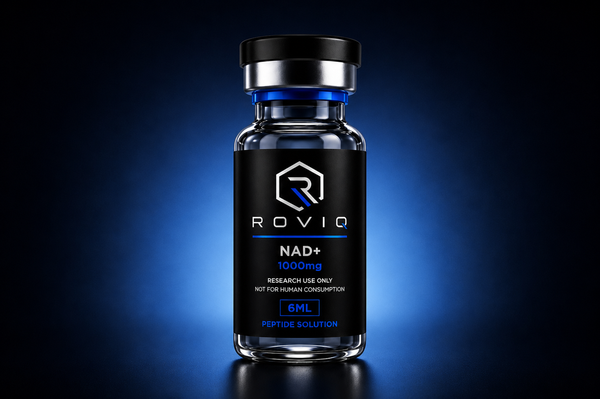
NAD+ (Nicotinamide Adenine Dinucleotide)
Nicotinamide adenine dinucleotide (NAD+) is a coenzyme studied for its essential role in cellular energy production. Research highlights its involvement in mitochondrial function, DNA repair, and cellular aging processes in laboratory models. As a central redox cofactor, NAD+ participates in hundreds of enzymatic reactions, making it one of the most widely examined molecules in cell biology.
Available Options
Research Context
Nicotinamide adenine dinucleotide (NAD+) is a ubiquitous coenzyme found in all living cells, where it functions as a redox carrier in metabolism and as a substrate for enzyme families including sirtuins, poly(ADP-ribose) polymerases (PARPs), and CD38. Because it sits at the intersection of energy metabolism and cellular signaling, NAD+ has become one of the most intensively studied small molecules in modern cell biology. It exists in oxidized (NAD+) and reduced (NADH) forms, and the ratio between them is used as an indicator of cellular redox state in experimental systems.
In vitro studies have characterized NAD+ as an obligatory cofactor for glycolysis, the tricarboxylic acid cycle, and oxidative phosphorylation, and have mapped how its intracellular concentration is maintained by salvage and de novo synthesis pathways. Animal model research has examined age-associated changes in tissue NAD+ levels and their relationship to mitochondrial function, DNA damage responses, and metabolic regulation. Human studies have largely focused on measuring NAD+ and its metabolites and on precursor compounds rather than on NAD+ itself, and the translational significance of these findings remains under investigation.
Open questions in the field include how NAD+ is compartmentalized within organelles, how its biosynthetic enzymes are regulated across tissues and disease states, and which downstream pathways are most sensitive to fluctuations in NAD+ availability. Our NAD+ and mitochondrial function research article reviews this landscape in more detail.
This material is supplied as a lyophilized powder with purity verified by HPLC and a published certificate of analysis. It is intended strictly for laboratory research use and is not for human or veterinary use.
Specifications
| Form | Lyophilized powder |
| Purity | >=99% (HPLC) |
| Molecular formula | C21H27N7O14P2 |
| Molecular weight | 663.4 g/mol |
| CAS | 53-84-9 |
| Storage | Store lyophilized at -20C; refrigerate (2-8C) after reconstitution |
Storage & Handling
Store the lyophilized powder at -20C, protected from light and moisture. After reconstitution, refrigerate at 2-8C and use promptly. For step-by-step handling, see our reconstitution and storage guide and the reconstitution calculator.
Certificate of Analysis
🛡 COA — 1000mgFurther Reading
Related Compounds
References
- Covarrubias AJ et al. NAD(+) metabolism and its roles in cellular processes during ageing. Nat Rev Mol Cell Biol. 2021. PMID 33353981
- McReynolds MR et al. Mechanisms of NAD+ Homeostasis in Aging and Disease. Annu Rev Nutr. 2026. PMID 42228871
- Sharma A et al. Potential Synergistic Supplementation of NAD+ Promoting Compounds as a Strategy for Increasing Healthspan. Nutrients. 2023. PMID 36678315