
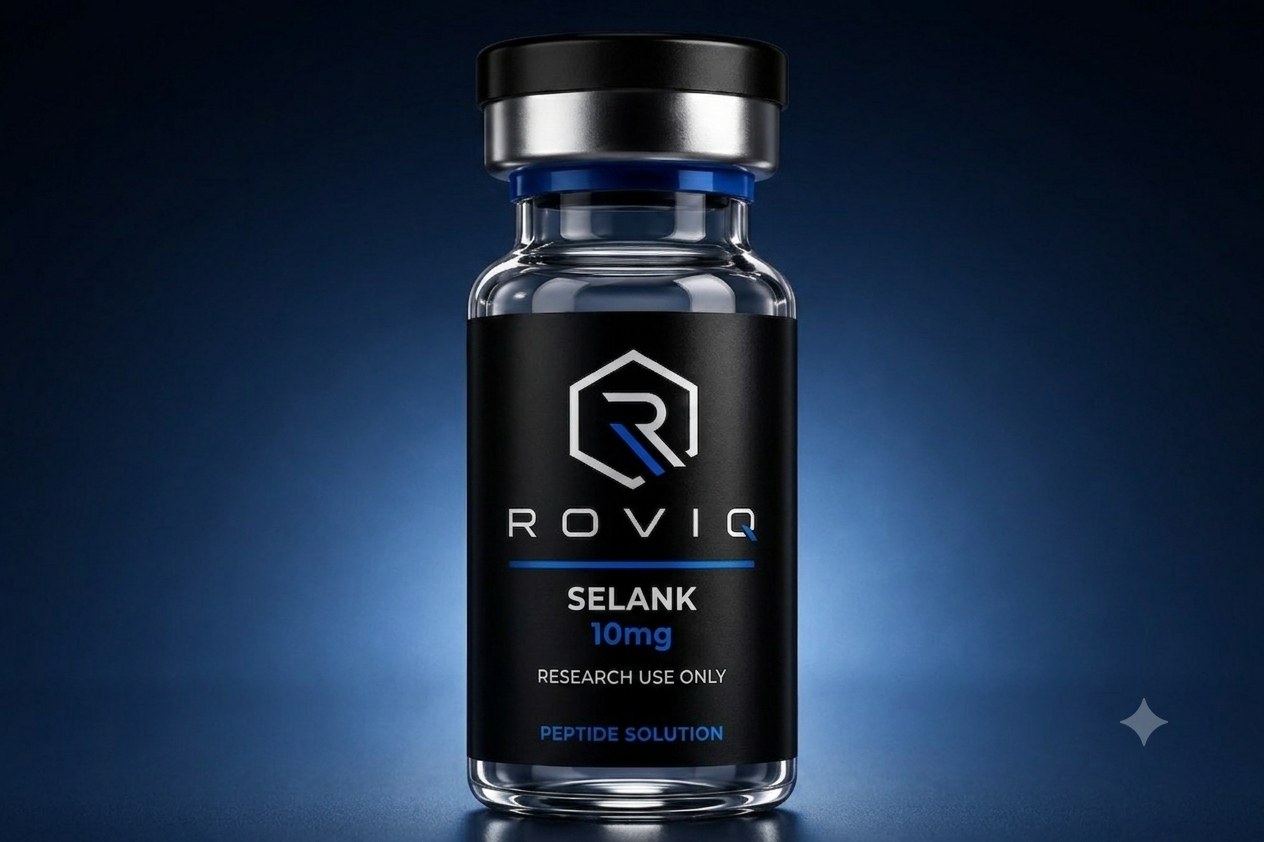
Selank
Selank is a synthetic heptapeptide analog of the endogenous immunomodulatory peptide tuftsin. Research examines its effects on neurotransmitter regulation and cognitive processes in experimental models, as well as its potential involvement in anxiety-related signaling and immune response pathways in laboratory settings.
Available Options
Research Context
Selank is a synthetic heptapeptide (Thr-Lys-Pro-Arg-Pro-Gly-Pro) built by appending a Pro-Gly-Pro sequence to tuftsin, a naturally occurring tetrapeptide fragment of the Fc region of immunoglobulin G. It was developed in Russia at the Institute of Molecular Genetics of the Russian Academy of Sciences, and much of the published literature on it originates from Russian research groups, appearing in journals such as Bulletin of Experimental Biology and Medicine, Molecular Immunology, and Regulatory Peptides.
The research landscape is dominated by preclinical work. Animal model studies in rats and mice have examined Selank's influence on gene expression in the brain and spleen, including inflammation-related genes, chemokines, cytokines, and their receptors, as well as anxiety-related signaling in experimental models. Rodent studies have also reported changes in BDNF content in the hippocampus and prefrontal cortex following ethanol-induced memory impairment, and effects on behavioral and molecular markers during morphine withdrawal. Transcriptomic work has mapped temporary dynamics of gene expression under Selank exposure in mouse spleen tissue.
A small number of human studies exist, primarily small Russian clinical investigations; however, the overall human evidence base is limited in size and scope, and results have not been broadly replicated by independent international groups. In vitro and molecular work has focused on how the peptide alters expression patterns of immune- and neurosignaling-related genes rather than on direct receptor binding characterization.
Open questions include the peptide's precise molecular targets, its pharmacokinetics and metabolic stability in different model systems, and whether findings from Russian-origin animal and small human studies generalize under independent replication. All materials are supplied strictly for laboratory research use.
Specifications
| Form | Lyophilized powder |
| Purity | >=99% (HPLC) |
| Sequence | Thr-Lys-Pro-Arg-Pro-Gly-Pro |
| Molecular weight | 751.9 g/mol |
| Storage | Store lyophilized at -20C; refrigerate (2-8C) after reconstitution |
Storage & Handling
Store Selank lyophilized at -20C, protected from light. After reconstitution, refrigerate at 2-8C and use promptly. See our peptide reconstitution and storage guide for detailed handling practices, and the reconstitution calculator for solution preparation math.
Certificate of Analysis
🛡 COA — 10mgRelated Compounds
References
- Siebert A et al. Tuftsin - Properties and Analogs. Curr Med Chem. 2017. PMID 28745220
- Kolik LG et al. Selank, Peptide Analogue of Tuftsin, Protects Against Ethanol-Induced Memory Impairment by Regulating of BDNF Content in the Hippocampus and Prefrontal Cortex in Rats. Bull Exp Biol Med. 2019. PMID 31625062
- Kolomin T et al. The temporary dynamics of inflammation-related genes expression under tuftsin analog Selank action. Mol Immunol. 2014. PMID 24291245
- Kolomin T et al. Expression of inflammation-related genes in mouse spleen under tuftsin analog Selank. Regul Pept. 2011. PMID 21609736