
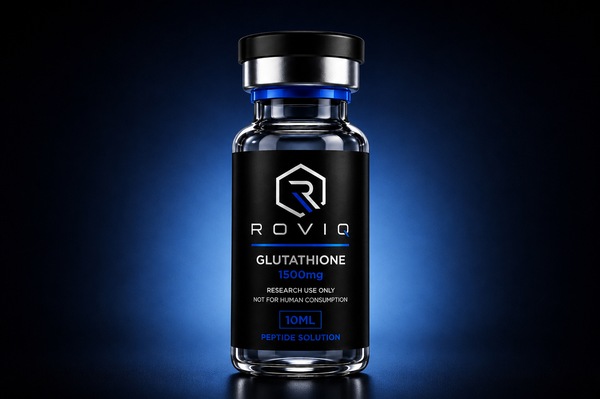
Glutathione
Glutathione is a powerful endogenous antioxidant tripeptide studied for its role in cellular protection, oxidative stress response, and immune modulation. Research models explore its influence on redox balance, detoxification pathways, and mitochondrial function in laboratory settings. As the most abundant low-molecular-weight thiol in cells, it serves as a central reference molecule in redox biology research.
Available Options
Research Context
Glutathione (gamma-L-glutamyl-L-cysteinylglycine, GSH) is a tripeptide synthesized in the cytosol of virtually all cells through the sequential action of glutamate-cysteine ligase and glutathione synthetase, the first two steps of the gamma-glutamyl cycle. It is the most abundant low-molecular-weight thiol in biological systems, present intracellularly at millimolar concentrations, and the ratio of its reduced (GSH) to oxidized (GSSG) forms is widely used as an indicator of cellular redox state. Because of this centrality, glutathione is one of the most extensively studied molecules in redox biology.
In vitro research has defined glutathione's biochemical roles in detail: it serves as a cofactor for glutathione peroxidases, a substrate for glutathione S-transferases in conjugation and detoxification reactions, and a participant in protein S-glutathionylation, a reversible post-translational modification increasingly studied as a redox signaling mechanism. Cell-culture models use glutathione manipulation to probe how redox balance influences mitochondrial function, enzyme activity, and responses to oxidative challenge.
Animal model studies have examined glutathione homeostasis using pharmacological depletion, genetic disruption of biosynthetic enzymes, and tissue-specific measurement, helping to characterize how different organs maintain redox balance and how mitochondrial glutathione pools are regulated. Human studies have largely measured glutathione status and its metabolites in clinical and physiological samples rather than intervening on the pathway directly, and the interpretation of these measurements remains an active methodological question. Open areas of investigation include how glutathione is compartmentalized between cytosol and organelles, how redox signaling achieves target specificity, and how biosynthetic capacity is regulated across cell states.
This material is supplied as a lyophilized powder with purity verified by HPLC and a published certificate of analysis. It is intended strictly for laboratory research use and is not for human or veterinary use.
Specifications
| Form | Lyophilized powder |
| Purity | >=99% (HPLC) |
| Sequence | gamma-Glu-Cys-Gly (gamma-L-glutamyl-L-cysteinylglycine) |
| Molecular formula | C10H17N3O6S |
| Molecular weight | 307.33 g/mol |
| CAS | 70-18-8 |
| Storage | Store lyophilized at -20C; refrigerate (2-8C) after reconstitution |
Storage & Handling
Store the lyophilized powder at -20C, protected from light and moisture. After reconstitution, refrigerate at 2-8C and use promptly. For step-by-step handling, see our reconstitution and storage guide and the reconstitution calculator.
Certificate of Analysis
🛡 COA — 1500mgRelated Compounds
References
- Forman HJ et al. Glutathione: overview of its protective roles, measurement, and biosynthesis. Mol Aspects Med. 2009. PMID 18796312
- Zhang H, Forman HJ. Glutathione synthesis and its role in redox signaling. Semin Cell Dev Biol. 2012. PMID 22504020
- Forman HJ. Glutathione - From antioxidant to post-translational modifier. Arch Biochem Biophys. 2016. PMID 27095218