
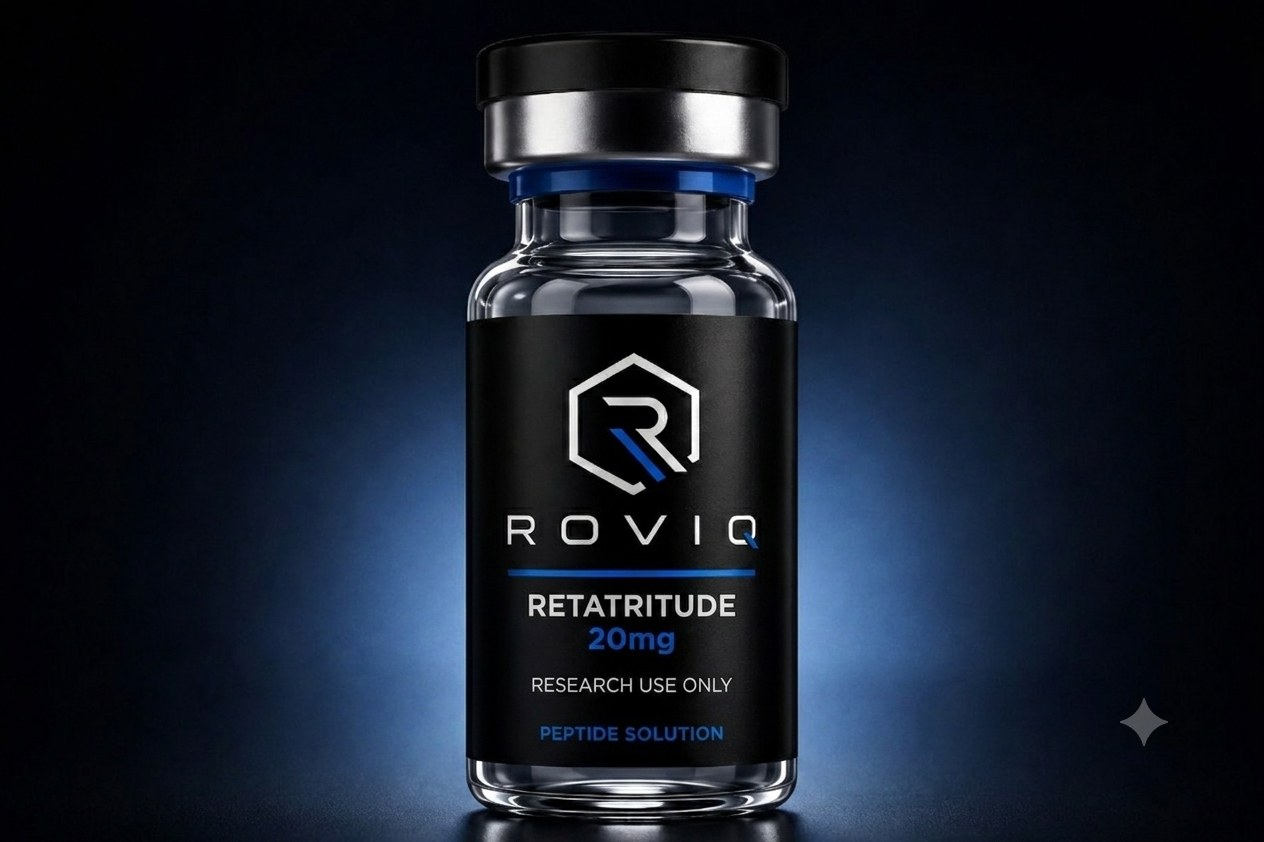
Retatrutide
Retatrutide is an investigational synthetic peptide studied as a triple receptor agonist at the glucose-dependent insulinotropic polypeptide (GIP), glucagon-like peptide-1 (GLP-1), and glucagon receptors. It is a 39-amino-acid modified peptide researched in experimental models of energy balance, glucose regulation, and related metabolic endpoints. It has not received regulatory approval in any jurisdiction and remains in clinical development. Sold in our catalog as GLP-3 20mg / GLP-3 30mg. For laboratory research use only.
Available Options
Research Context
Retatrutide (development code LY3437943) is a 39-amino-acid synthetic peptide engineered on a GIP-backbone scaffold, incorporating non-natural residues (including aminoisobutyric acid and alpha-methyl-leucine substitutions) and a C20 fatty-diacid side chain that extends its circulating half-life to approximately six days in human pharmacology studies. As a single molecule it activates three distinct receptors — GIP, GLP-1, and glucagon — with a potency balance deliberately weighted toward the GIP and glucagon components relative to earlier dual agonists.
The published human evidence is early-phase and should be read as such. A phase 2 randomized controlled trial in adults with obesity (Jastreboff and colleagues, 2023, N Engl J Med) measured body weight change and cardiometabolic endpoints over 48 weeks of treatment. A separate phase 2 trial in adults with type 2 diabetes (Rosenstock and colleagues, 2023, Lancet) measured HbA1c and body weight against both placebo and an active comparator over 24 weeks. A phase 2a trial in adults with metabolic dysfunction-associated steatotic liver disease (Sanyal and colleagues, 2024, Nat Med) measured liver fat content by MRI-based methods. These are controlled trial data in defined patient populations; they are not evidence of effect in any other context, and the compound's phase 3 program is still in progress.
Open questions in the research landscape include the relative contribution of glucagon receptor agonism to energy expenditure versus glycemic endpoints, the durability of observed effects beyond the studied treatment windows, and how the triple-agonist profile compares with dual GIP/GLP-1 agonism in longer-duration studies. In laboratory settings, retatrutide also serves as a tool compound for dissecting multi-receptor incretin and glucagon signaling pathways.
This material is supplied as a lyophilized powder with purity verified by HPLC and a published certificate of analysis. It is intended strictly for laboratory research use and is not for human or veterinary use.
Specifications
| Form | Lyophilized powder |
| Purity | >=99% (HPLC) |
| Structure | 39-amino-acid modified peptide with C20 fatty-diacid side chain |
| Molecular formula | C221H342N46O68 |
| Molecular weight | 4731.3 g/mol |
| CAS | 2381089-83-2 |
| Storage | Store lyophilized at -20C; refrigerate (2-8C) after reconstitution |
Storage & Handling
Store the lyophilized powder at -20C, protected from light and moisture. After reconstitution, refrigerate at 2-8C and use the solution promptly.
For handling guidance, see our peptide reconstitution and storage guide, and use the reconstitution calculator to plan solution volumes for laboratory work.
Certificate of Analysis
🛡 COA — 20mg 🛡 COA — 30mgRelated Compounds
References
- Jastreboff AM et al. Triple-hormone-receptor agonist retatrutide for obesity - a phase 2 trial. N Engl J Med. 2023. PMID 37366315
- Rosenstock J et al. Retatrutide, a GIP, GLP-1 and glucagon receptor agonist, for people with type 2 diabetes: a randomised, double-blind, placebo and active-controlled, parallel-group, phase 2 trial conducted in the USA. Lancet. 2023. PMID 37385280
- Sanyal AJ et al. Triple hormone receptor agonist retatrutide for metabolic dysfunction-associated steatotic liver disease: a randomized phase 2a trial. Nat Med. 2024. PMID 38858523