
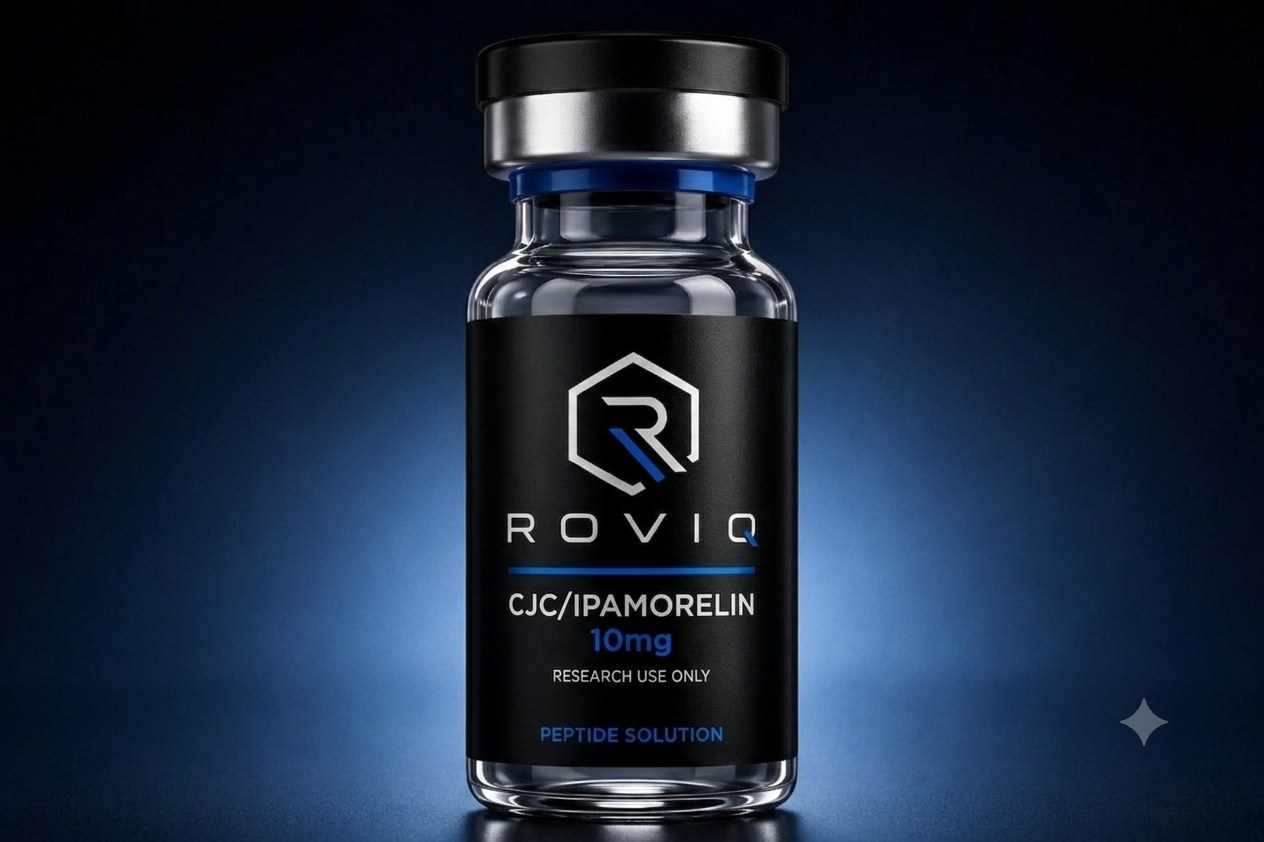
CJC-1295 + Ipamorelin Blend
This combination pairs CJC-1295, a long-acting analog of growth hormone-releasing hormone (GHRH), with ipamorelin, a selective agonist of the ghrelin receptor GHS-R1a. It is studied for its complementary role in stimulating growth hormone release through two distinct receptor pathways. CJC-1295 and ipamorelin are commonly researched together for their effects on hormone signaling and metabolic processes in controlled laboratory settings.
Available Options
Research Context
CJC-1295 and ipamorelin are two synthetic peptides that converge on the growth hormone axis through complementary targets. CJC-1295 is a long-acting analog of growth hormone-releasing hormone (GHRH), the hypothalamic peptide that regulates growth hormone secretion from the anterior pituitary; amino acid substitutions in the native sequence confer resistance to enzymatic cleavage, prolonging its activity in circulation. Ipamorelin is a pentapeptide agonist of the growth hormone secretagogue receptor GHS-R1a (the ghrelin receptor). Because GHRH analogs and GHS-R1a agonists act through distinct receptors, the combination is studied as a model of dual-pathway stimulation of growth hormone release.
The evidence base for the two components differs in kind. CJC-1295 has been examined in a human study: a randomized, double-blind, placebo-controlled trial in healthy adults (Teichman and colleagues, 2006) characterized its pharmacokinetic and pharmacodynamic profile, reporting sustained changes in growth hormone and IGF-I measurements following subcutaneous administration. Ipamorelin's characterization has been largely preclinical — the original report (Raun and colleagues, 1998) established its selectivity in vitro and in animal models, and later animal research examined it in a rodent model of postoperative ileus (Venkova and colleagues, 2009).
Although the pairing is frequently discussed in the research community, the specific CJC-1295 plus ipamorelin combination has not been characterized as a fixed preparation in peer-reviewed literature; published studies examine the components individually. Open questions include how concurrent GHRH and GHS-R1a stimulation affects pulsatile growth hormone dynamics in controlled models, and whether the complementary receptor mechanisms produce additive or otherwise distinct signaling profiles in vitro.
This material is supplied as a lyophilized powder with purity verified by HPLC and a published certificate of analysis. It is intended strictly for laboratory research use and is not for human or veterinary use.
Specifications
| Form | Lyophilized powder |
| Purity | >=99% (HPLC) |
| Sequence (ipamorelin) | Aib-His-D-2-Nal-D-Phe-Lys-NH2 |
| Molecular weight (ipamorelin) | 711.9 g/mol |
| Storage | Store lyophilized at -20C; refrigerate (2-8C) after reconstitution |
Storage & Handling
Store the lyophilized powder at -20C, protected from light and moisture. After reconstitution, refrigerate at 2-8C and use the solution promptly.
For handling guidance, see our peptide reconstitution and storage guide, and use the reconstitution calculator to plan solution volumes for laboratory work.
Certificate of Analysis
🛡 COA — CJC-1295 5mg / Ipamorelin 5mgRelated Compounds
References
- Teichman SL et al. Prolonged stimulation of growth hormone (GH) and insulin-like growth factor I secretion by CJC-1295, a long-acting analog of GH-releasing hormone, in healthy adults. J Clin Endocrinol Metab. 2006. PMID 16352683
- Raun K et al. Ipamorelin, the first selective growth hormone secretagogue. Eur J Endocrinol. 1998. PMID 9849822
- Venkova K et al. Efficacy of ipamorelin, a novel ghrelin mimetic, in a rodent model of postoperative ileus. J Pharmacol Exp Ther. 2009. PMID 19289567